
Press Release: TVA’s 2026 Integrated Resource Plan Scales Back Wind Energy While Increasing Reliance on Natural Gas
For Immediate Release: June 26, 2026
Media Contact: Sarah Eazzetta, sarahe@sewind.org
Knoxville, T.N. — This week, the Tennessee Valley Authority (TVA) filed their 2026 Preliminary Final Integrated Resource Plan (IRP), outlining the utility's long-term strategy for meeting growing electricity demand across its seven-state service territory. Compared to the draft 2025 IRP, the updated plan significantly reduces the role of wind energy while expanding reliance on natural gas including 4 to 13 GW of new combined-cycle and 3 to 13 GW of new combustion turbine capacity through 2040 and extending operation of coal assets into the 2040s.
The 2026 IRP marks a notable shift in how wind is incorporated into TVA's long-term planning. The 2025 IRP, which was tabled after the TVA Board lost a quorum last July, identified up to 4 GW of wind energy additions by 2035 to increase portfolio diversity. By comparison, the Preliminary Final 2026 IRP no longer identifies a standalone wind deployment target, recommends suspending additional wind development due to "cost and portfolio fit challenges," and selects only limited amounts of wind in just two portfolios under the High Growth scenario, largely removing wind from TVA's preferred resource pathway. Additionally, the 2026 IRP eliminated high-voltage direct current (HVDC) wind imports as a planning option, narrowing TVA's wind resource offerings from three technologies in the 2025 plan — Midwest, Southeast high-hub, and HVDC-imported wind — to two.
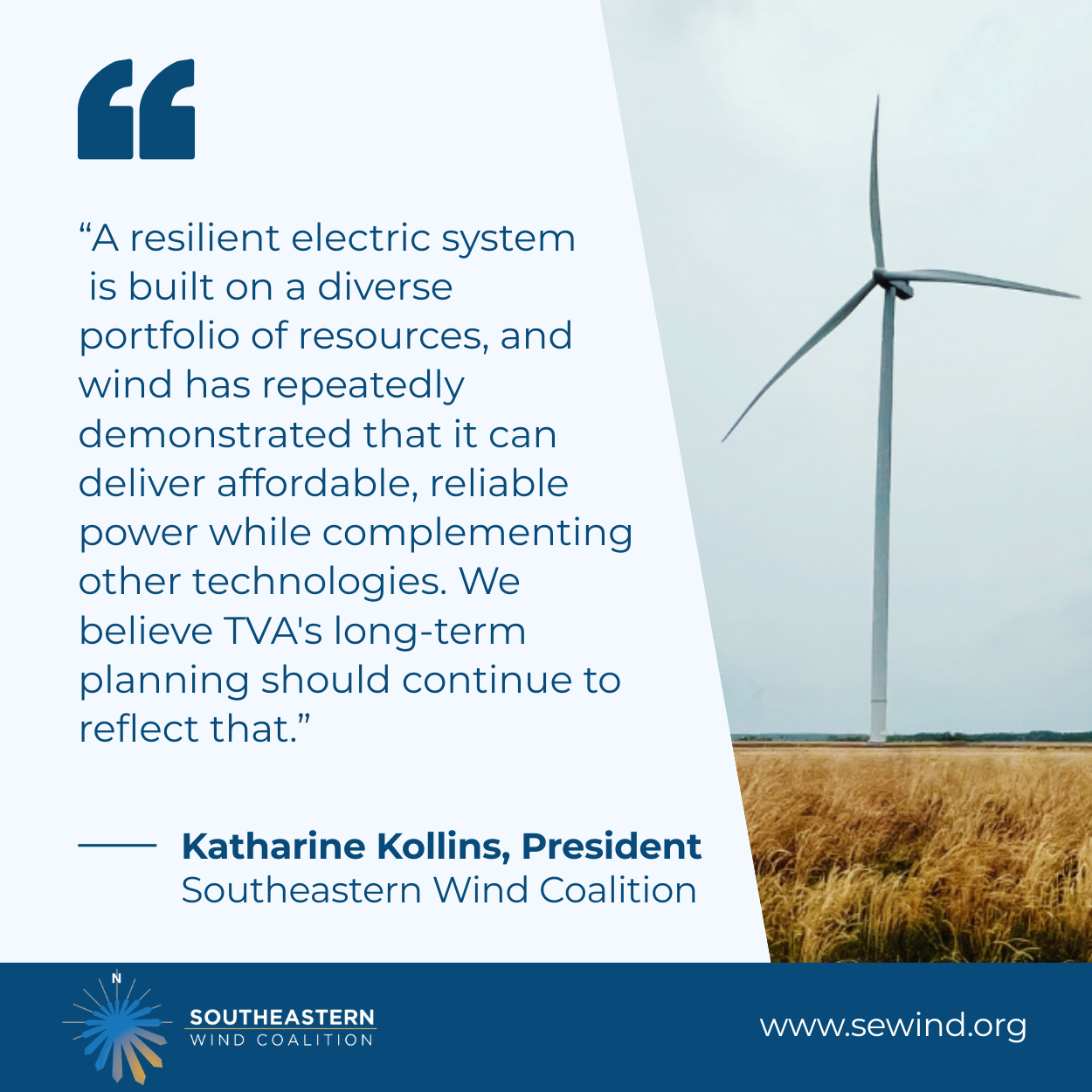
"A resilient electric system is built on a diverse portfolio of resources, and wind has repeatedly demonstrated that it can deliver affordable, reliable power while complementing other technologies. We believe TVA's long-term planning should continue to reflect that," said Katharine Kollins, President of the Southeastern Wind Coalition.
TVA projects that electricity demand could grow by roughly 16% by 2040 in its Reference scenario, and by as much as 60% in its highest-growth case, driven largely by data center development, advanced manufacturing, population growth, and broader economic expansion throughout the Valley. As electricity needs continue to grow, maintaining a balanced generation portfolio that includes wind alongside other proven technologies can help improve long-term reliability, affordability, and resilience for TVA's customers.
TVA is inviting public review and comments on the draft IRP until July 22 alongside a Public Webinar July 2. TVA will present the IRP recommendations and an accompanying Environmental Impact Statement (EIS) to TVA's Board of Directors for consideration at the August Board meeting.
About SEWC
The Southeastern Wind Coalition is a 501(c)(3), nonpartisan organization that works to advance the land-based and offshore wind industry in the Southeast. We focus on providing fact-based information on the economic and environmental opportunities of wind energy, and encourage solutions that result in net economic benefits to residents and ratepayers. For more information about the Southeastern Wind Coalition, visitwww.sewind.org