
Press Release: Kentucky Enacts HB 677 Creating New Wind Energy Restrictions
For Immediate Release: April 29, 2026
Media Contact: Holly Elliott, hollye@sewind.org
Frankfort, KY — April 29, 2026 — On April 14, 2026, House Bill 677 became law without the Governor’s signature in Kentucky, establishing a new regulatory framework for carbon dioxide sequestration while also introducing significant new restrictions on wind energy development.
A late-stage amendment to the bill imposes statewide limits on wind turbine height, expands setback requirements, and adds new operational and financial obligations for wind projects.
Key Provisions Affecting Wind Energy:
Statewide Height Limit: Wind turbines are now capped at 350 feet, measured from ground level to the hub. This represents a new restriction not previously in state law.
Setbacks: Must be 1,000 feet from property lines, 2,000 feet from homes, schools, hospitals, and nursing facilities.This applies to both energy generation and storage infrastructure
Local Government Authority: Counties and municipalities with planning and zoning authority may establish their own height and setback requirements, which override state standards. Critically, these local rules cannot be waived or modified by the Public Service Commission, effectively giving local governments final authority over whether wind projects can move forward.
Decommissioning Bonds: Increases financial obligations for decommissioning by requiring full-cost bonding with no credit for salvage value.
Operations: Requires limited lighting, shadow flicker mitigation, and removal of replaced components within 90 days.
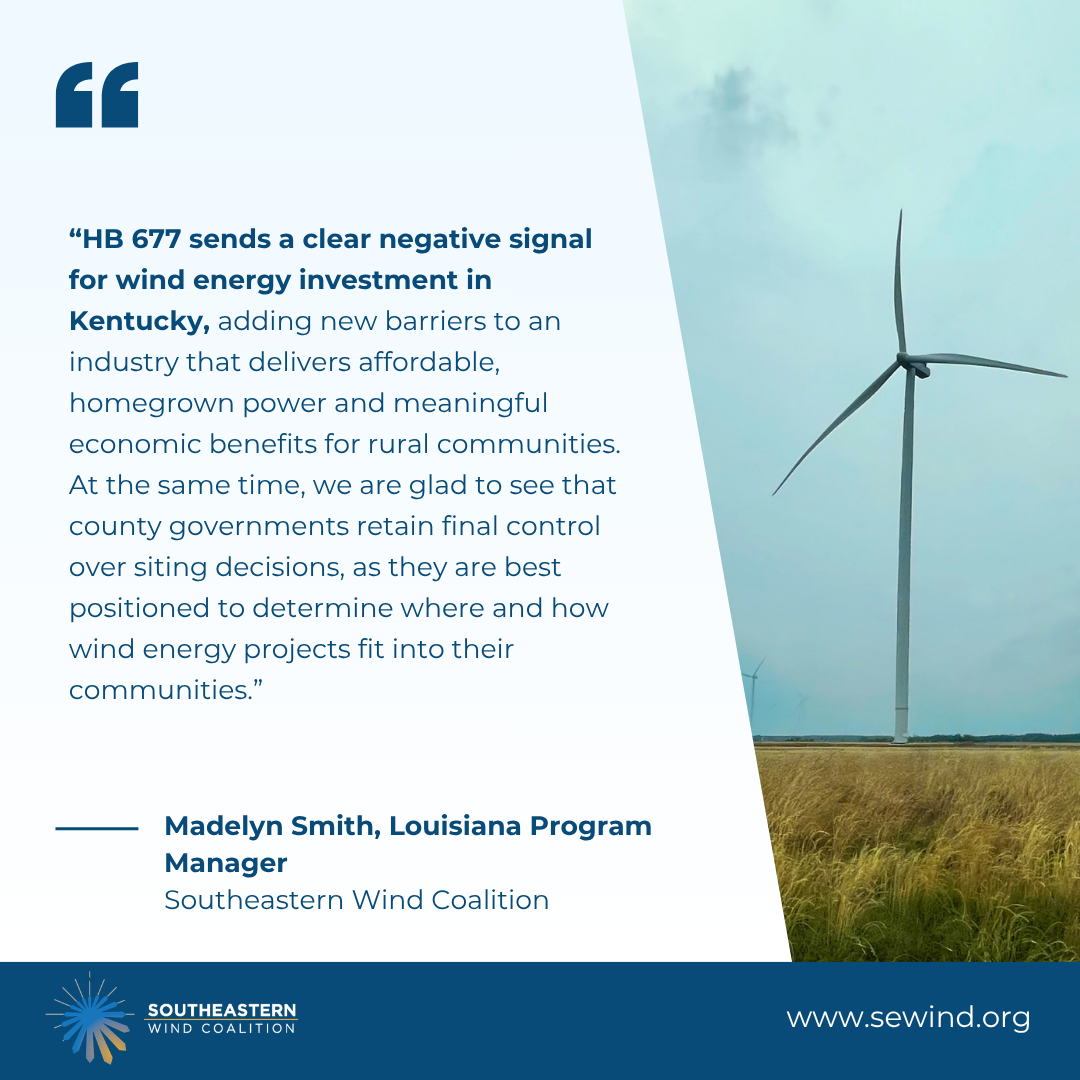
“HB 677 sends a clear negative signal for wind energy investment in Kentucky, adding new barriers to an industry that delivers affordable, homegrown power and meaningful economic benefits for rural communities,” said Madelyn Smith, Program Manager at the Southeastern Wind Coalition. “At the same time, we are glad to see that county governments retain final control over siting decisions, as they are best positioned to determine where and how wind energy projects fit into their communities.”
These regulatory changes come as advances in turbine technology are improving wind energy viability across the Southeast. Modern turbines, often exceeding 600 to 700 feet in total height, are capable of accessing stronger, more consistent wind resources at higher elevations.
In neighboring states such as Mississippi and Arkansas, utility-scale projects using taller turbines are already operating or under development. By establishing a 350-foot height cap, HB 677 may limit access to these higher-quality wind resources, potentially affecting the cost and scalability of future energy projects in Kentucky. The policy could also reduce associated economic benefits, including landowner lease income, local tax revenues, and job creation in rural communities.
The Southeastern Wind Coalition will continue to engage with policymakers and community leaders to provide fact-based information on wind energy and support policies that expand access to reliable, affordable, and locally beneficial energy resources.
About SEWC
The Southeastern Wind Coalition is a 501(c)(3), nonpartisan organization that works to advance the land-based and offshore wind industry in the Southeast. We focus on providing fact-based information on the economic and environmental opportunities of wind energy, and encourage solutions that result in net economic benefits to residents and ratepayers. For more information about the Southeastern Wind Coalition, visitwww.sewind.org