
For Immediate Release: November 16, 2026
Media Contact: Lauren McKinnis, laurenm@sewind.org
Raleigh, N.C. - Yesterday, the North Carolina Utilities Commission (“NCUC” or “Commission”) issued an order for Duke Energy’s combined Carbon Plan and Integrated Resource Plan (“Carbon Plan”). The Carbon Plan is mandated through HB951 and requires the NCUC to take ‘all reasonable steps’ to achieve carbon neutrality by 2050 using a least-cost approach.
The Commission’s order approves Duke’s Recommended Portfolio that includes a set of near-term actions to meet growing electricity demand and maintain reliability. The approved actions move forward with new natural gas generation, extending coal retirements, expanding solar and battery energy storage, and preserving development options for new nuclear and pumped-storage hydropower.
While onshore and offshore wind resources were not included as part of Duke Energy’s recommended portfolio or the Commission’s approved near-term action plan, the order directs the utility to take reasonable and prudent steps towards evaluating the amount and timing of both resources in its next Carbon Plan. The Commission’s approved near-term action plan for wind resources direct Duke Energy to:
Monitor the federal and state policy environment for impacts to the potential development and future availability of onshore wind in North Carolina;
Conduct moderate development activities to determine the viability of onshore wind in North Carolina;
Monitor progress of the domestic offshore wind industry, including construct, market conditions, supply chain factors, federal and state policy and regulatory environment for impacts to the potential development of offshore wind in NC;
Evaluate the amount and timing of onshore wind and offshore wind resources in its next Carbon Plan IRP.
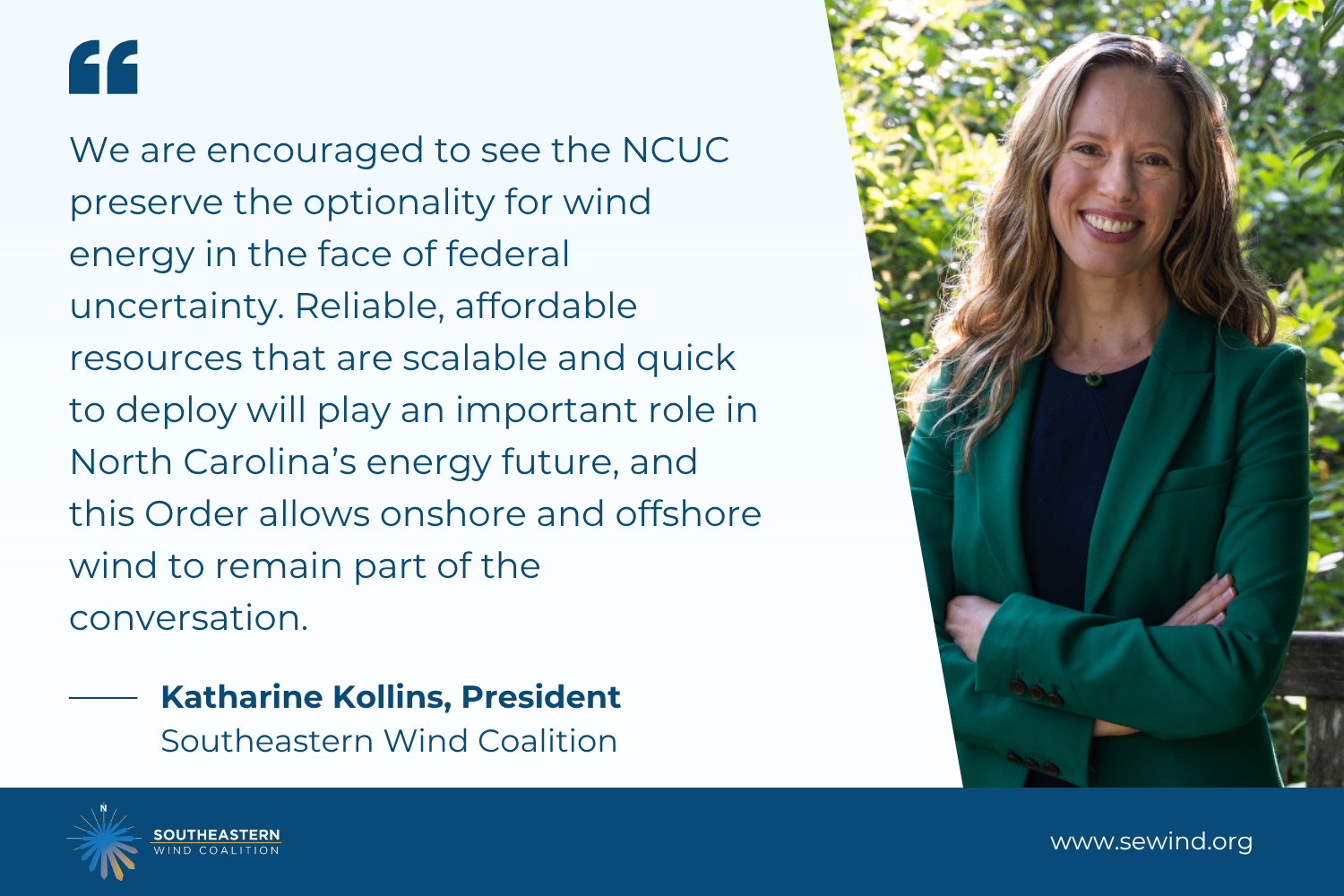
Katharine Kollins, President of the Southeastern Wind Coalition, stated “We are encouraged to see the NCUC preserve the optionality for wind energy in the face of federal uncertainty. Reliable, affordable resources that are scalable and quick to deploy will play an important role in North Carolina’s energy future, and this Order allows onshore and offshore wind to remain part of the conversation.”
Karly Brownfield, Senior Program Manager, added “As Duke continues to plan for winter capacity needs, wind's performance has already been proven on other systems across the country. During Winter Storm Fern in 2026, onshore wind was nearly double Texas grid operators’ expectations. Operating U.S. offshore wind projects like South Fork Wind and Vineyard Wind provided 52% and 75% average capacity factors, respectively, comparable to coal and gas generation during Fern. This speaks volumes to the value wind can bring to North Carolina in terms of reliability during extreme weather, insulating ratepayers from volatile fuel costs during peak periods, and keeping the lights on.”
About the Southeastern Wind Coalition
The Southeastern Wind Coalition (SEWC) is a 501(c)(3) that works to advance the land-based and offshore wind industry in the Southeast. SEWC focuses on supply chain growth, economic development, job growth, and wind energy development in the region with solutions that are beneficial to industry, utilities, and result in net economic benefits to ratepayers. For more information about the Southeastern Wind Coalition visit http://www.sewind.org.
