
Faces of Wind: Turning Turbine Blades into Tomorrow’s Infrastructure with Neocycling

Chris G. Thodos
Managing Partner of NEOCYCLING
As wind energy continues to pop up in the United States, so does an important question: what happens to turbine blades when they reach the end of their life?
Wind turbine blades are engineered to withstand decades of harsh conditions, combining exceptional durability with lightweight design. While these qualities present challenges for traditional recycling methods, they also open the door to innovative approaches. By 2030, more than 1.5 million tons of retired blade material will become available worldwide—creating a unique opportunity to develop forward-thinking, and creative solutions.
For NEOCYCLING that challenge is exactly where the opportunity begins.
The company was founded on a simple but powerful idea: wind energy should be sustainable from start to finish. Through its proprietary ECOCYCLING process, NEOCYCLING has developed a way to transform retired turbine blades into high-value materials used in concrete and asphalt. With decades of success in Europe, the company is now bringing that experience and technology to the United States.
The inspiration behind NEOCYCLING comes from a long-standing industry dilemma: wind turbine blades are made from advanced composite materials, typically fiberglass bound together with thermoset resins, that are built to endure. Unlike many other materials, these resins can’t simply be melted down and reused, which has made recycling both technically difficult and costly. As more turbines from early wind projects are decommissioned, the scale of the issue has become impossible to ignore. Landfilling is no longer a sustainable option.
“The lessons learned in Europe are directly informing NEOCYCLING’s approach to the burgeoning U.S. market. Rather than starting from scratch, they are deploying a proven, scalable technology and a vertically integrated business model that covers everything from facility design to operations. This allows us to offer a turnkey solution to the growing challenge of wind turbine blade waste in the U.S.” said Chris G. Thodos, Managing Partner of NEOCYCLING. “By leveraging their European successes, NEOCYCLING is well-positioned to replicate a circular economy model, turning a potential environmental liability into a sustainable and profitable enterprise.”
NEOCYCLING’s work in Europe has helped demonstrate what’s possible. Through a multi-year collaboration with GE Renewable Energy in Europe, the company supported the dismantling and recycling of decommissioned turbines, helping to establish a practical, circular approach to blade waste. That experience allowed NEOCYCLING to refine both its technology and its business model, proving that recycling turbine blades can be not only environmentally responsible, but also commercially viable and scalable
Those lessons are now shaping the company’s expansion into the U.S. market, with a modular design that can be adapted to regional needs, while offering a complete solution for a growing national challenge.
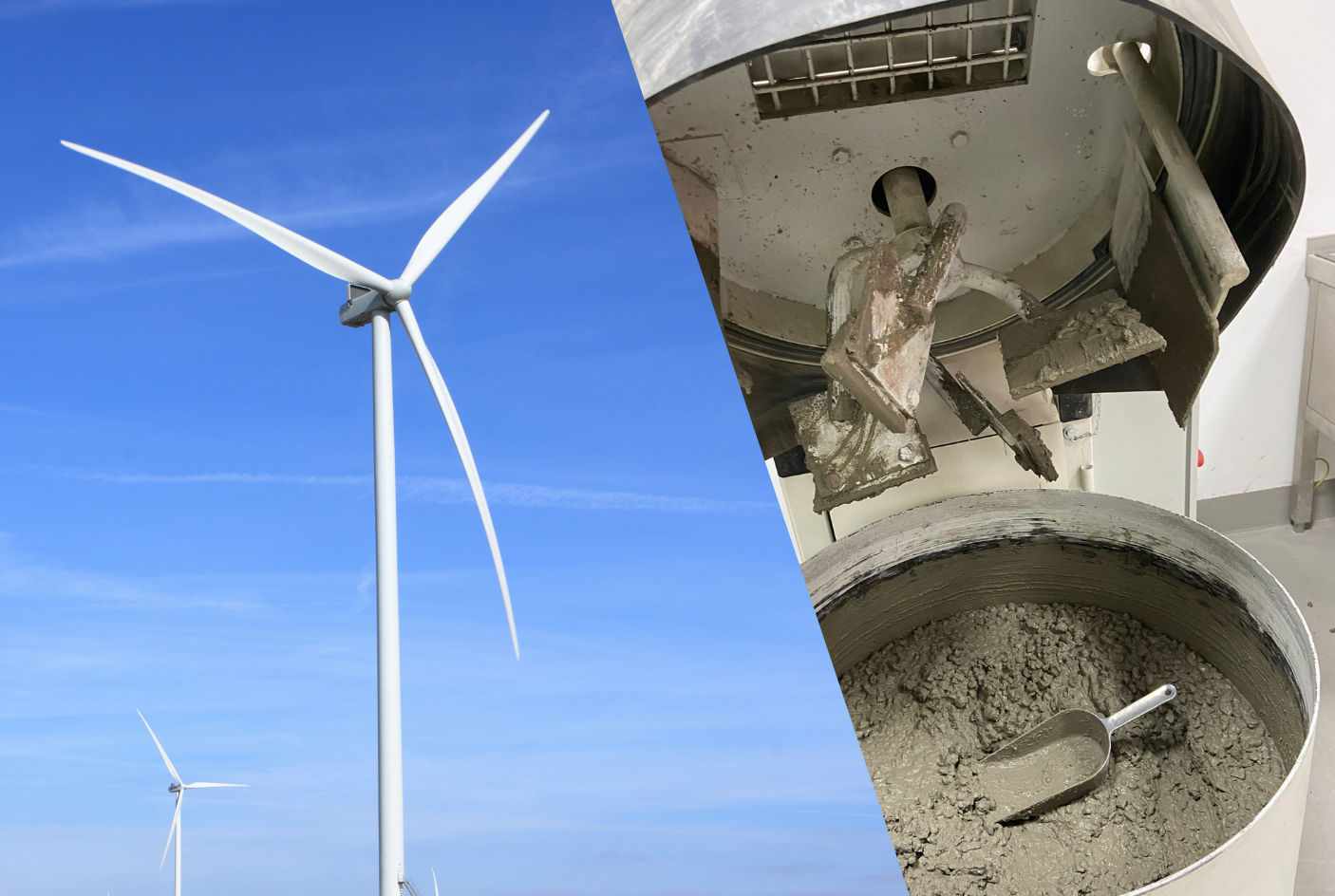
At the center of it all is the company’s patented ECOCYCLING process. It starts with cutting the blades then loading these blades into a mobile grinder on-site, followed by a multi-stage grinding and separation process at a dedicated facility. Using a controlled mechanical high speed grinding approach, the system breaks down the complex composite materials and converts them into high-quality silica sand, creating a valuable ingredient in concrete manufacturing.
What makes this process different is its efficiency and autonomy. It operates at normal atmospheric pressure and doesn’t require an external energy source, instead drawing on the reactive properties within the material itself. The result is a lower-emissions process while producing a high-quality end product with real-world applications.
The silica sand created through ECOCYCLING can be used in a range of construction and infrastructure projects, from concrete blocks and tilt-up panels to more specialized industrial uses. In some cases, the resulting materials even outperform traditional options, offering added fire resistance and flexibility.
There is a growing interest in how recycled blade materials can be used in transportation. When incorporated into asphalt, these materials can improve durability, reduce cracking, and extend the lifespan of roadways. Collaboration with researchers, transportation institutes and several departments of transportation, including work connected to Texas A&M, are helping explore these possibilities further, especially in regions where infrastructure faces extreme weather and heavy use.
What makes all of this especially compelling is the potential broader impact. Repurposing turbine blades reduces the need for virgin materials like sand and gravel, cuts down on emissions tied to extraction and transport, and keeps large volumes of waste out of landfills. It’s a clear example of a circular economy in action: one where one industry’s waste becomes another’s abundant resource.
For NEOCYCLING, this is about more than solving a technical challenge. It’s about strengthening the long-term sustainability of wind energy itself. By addressing what happens at the end of a turbine’s life, the industry can move closer to a truly closed-loop system, and one that reflects the same forward-thinking values that drive renewable energy forward.
As wind energy development continues to expand across the Southeast, solutions like blade recycling will play an increasingly vital role in shaping its future. Companies like NEOCYCLING are helping ensure that when a turbine stops spinning, it can help build the next generation of projects.