
By Madelyn Smith, Senior Program Manager
Arkansas has some of the best wind resources and one of the most active wind project pipelines in the Southeast. As more counties work to draft wind ordinances and Arkansas implements Act 945, the Arkansas Wind Energy Development Act passed in 2025, more questions are being asked about a critical piece of wind regulation: setbacks.
What are setbacks?
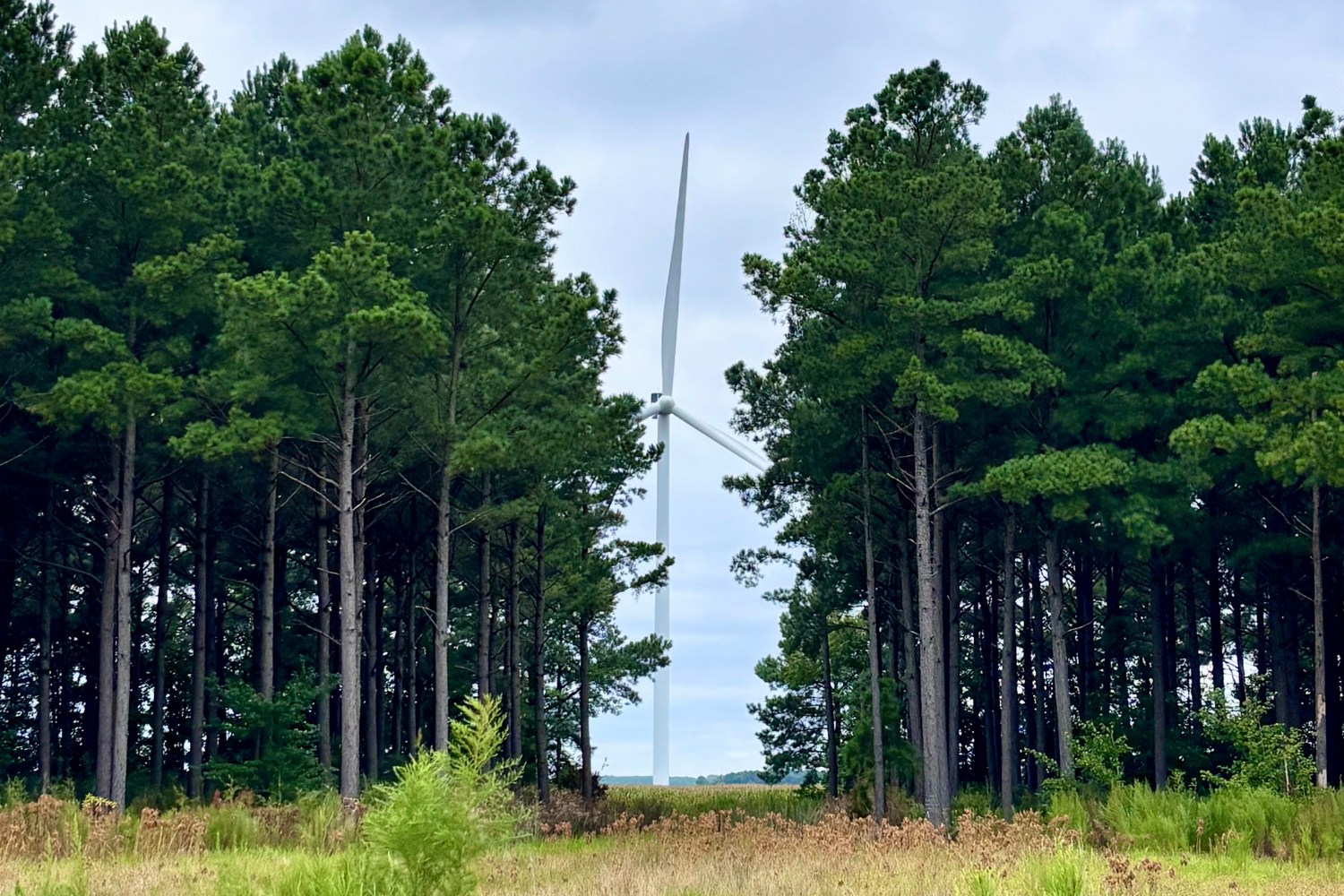
Setbacks are the minimum required distance between a wind turbine and property lines, buildings, roads, or natural resources. They're a standard part of wind ordinances and local zoning nationwide, and they exist for good reason.
A setback is a way to balance responsible wind development with the interests of nearby neighbors. It provides important protections for safety, while helping address two of the most common concerns about turbines: noise and shadow flicker.
Safety: Setbacks keep turbines a safe distance from occupied homes, roads, and public infrastructure. They also create a buffer between the property owners who choose to host turbines and neighbors who don't.
Noise: Modern turbines are remarkably quiet. Often, the sound of the wind itself is louder than the turbine spinning in it. A reasonable setback helps soften the low "whoosh" made as the blades pass through the air. The U.S. Department of Energy estimates that land-based, utility-scale turbines produce roughly 35–45 decibels at about 1,000 feet away — quieter than a running refrigerator, which clocks in around 50 decibels. It's one reason first-time visitors to an operating wind farm are often surprised by how little they hear.
Shadow flicker: Setbacks also help manage shadow flicker,the moving shadow cast when a turbine's rotating blades pass between the sun and an observer. While it’s a real effect, it is predictable and manageable. Setbacks, paired with basic siting analysis, ensure that shadow flicker doesn't affect nearby homes or occupied buildings.
In short: setbacks, sized correctly, are a reasonable tool for balancing responsible development with neighbors' quality of life.
What Are Reasonable Setback Requirements?
Setbacks are typically calculated relative to a turbine's tip height — the highest point the blade reaches — so taller turbines carry larger setbacks. This is a sensible, scalable approach.
Industry standard setback requirements typically require a turbine is 1.1 times turbine height away from non-participating property lines and 2.1 times turbine height away from nearby homes or community buildings not participating in the project, according to the American Clean Power Association's Model Wind Ordinance. Anything significantly beyond that stops functioning as a safety buffer and starts functioning as a barrier to development.
For the taller, high-hub-height turbines most commonly proposed in the Southeast, this looks like a setback of about five football fields, or just over a quarter mile, from occupied structures. That's enough distance to address noise and shadow flicker without walling off the vast majority of otherwise viable land.
Why Are Wind Developers Looking for Exemptions to the Setback Requirements in the Arkansas Wind Energy Development Act?
A common way for opponents to block wind development without saying so outright is to push for setbacks so large that they remove too much usable land from consideration, effectively engineering a moratorium while calling it a "safety standard."
This is how the setback requirements codified by theArkansas Wind Energy Development Act are designed. Act 945 is one of the most restrictive wind siting laws in the region. Its provisions add up to a de facto ban on new wind development in Arkansas. This is why any additional wind projects will need an exemption from the Act's siting requirements just to move forward.
Specifically, Act 945 requires:
Setbacks of up to 1 mile from schools, hospitals, parks, churches, and airports
Setbacks of 3.5 times turbine height from non-participating landowners — far beyond national norms
Fortunately, Act 945 allows for wind projects under development before April 9, 2025 to apply to the Public Service Commission for an exemption to Act 945. A project qualifies as under development if it meets just one of three criteria as of that date:
Executed land leases with participating landowners
Commenced necessary state or federal studies related to construction of the facility
Commenced construction
The Impact of Excessive Setbacks
Setbacks like the ones in Act 945 don't just slow projects down. They carry real costs for Arkansas:
Excessive setback requirements strip landowners of property rights they would otherwise use to responsibly earn additional income from their own land.
Arkansas risks losing clean energy investment already in the pipeline, as projects look to states with workable rules.
Counties could miss out on tens of millions of dollars in local tax revenue per project — revenue that funds schools, roads, and emergency services without raising local tax rates.
Communities lose new income streams that would otherwise support farmers, schools, and first responders.
Rather than a one-size-fits-all, statewide standard that functions as a ban, counties should have the flexibility to set their own reasonable setback requirements. These setbacks should be grounded in safety and science, not intended to stop development altogether. That's the difference between a rule that protects neighbors and one that protects the status quo.